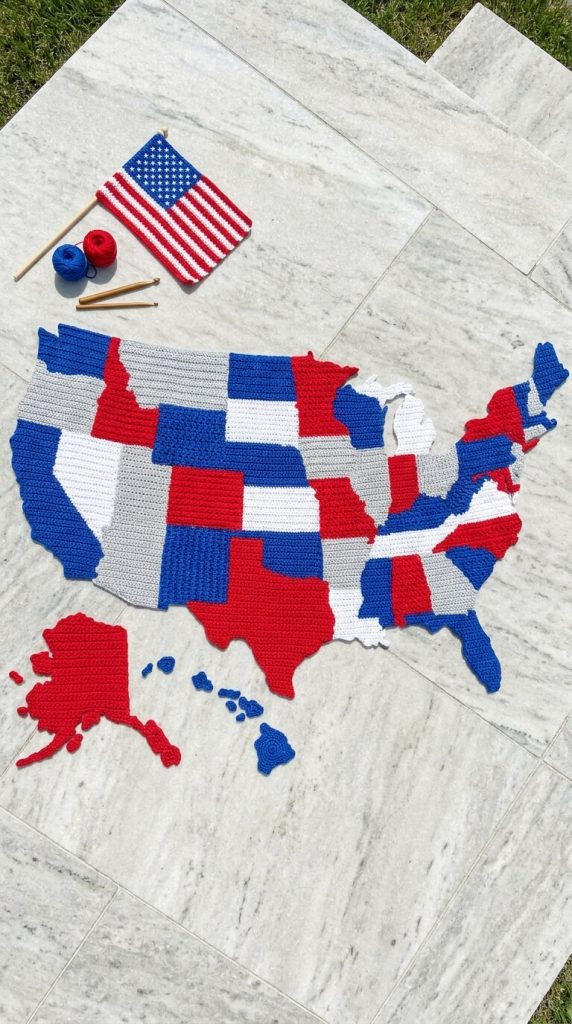
The crocheted map of the United States shown in the image is a striking example of modern tapestry or intarsia crochet. It features the contiguous 48 states worked in large blocks of red, white, blue, and gray, with Alaska and Hawaii made as separate pieces and placed below. A small American flag, yarn balls, and crochet hooks complete the patriotic display. This type of project is popular for Independence Day décor, classroom teaching tools, wall hangings, or as the centerpiece of a large afghan.
Below is a detailed, accurate guide to understanding and recreating a project of this style.
Understanding the Design Style
This map is not a highly detailed geographic outline. Instead, it uses a simplified, blocky, almost pixel-art approach in which groups of states or large regions are worked in solid colors. The color placement creates a strong visual impact while remaining manageable to crochet. Alaska is shown in solid red and Hawaii as a small chain of blue islands, which is a common and practical way to include the non-contiguous states without distorting the main map.
The technique used is almost always one of the following:
- Tapestry crochet (carrying unused colors along the back)
- Intarsia crochet (using separate yarn bobbins for each color section)
- Graphghan / corner-to-corner (C2C) or single-crochet graph work
Single crochet is the most common stitch because it creates a firm, dense fabric that holds the shape of the map well.
Materials Needed
- Worsted-weight (category 4) acrylic or cotton yarn in:
- Red
- White
- Blue (navy or royal)
- Light gray or silver (for the neutral states)
- Crochet hook: 4.5 mm – 5.5 mm (H/8 or I/9), depending on desired firmness
- Yarn needle
- Scissors
- Stitch markers
- Optional: blocking mats and pins, fabric backing or stiffener for a wall hanging, wooden dowel for hanging
Yardage varies greatly with size. A large wall-hanging map (roughly 3–4 feet wide) typically requires 800–1500 yards total, with more of the dominant colors.
How the Map Is Constructed
1. Creating or Obtaining a Chart Most makers start with a graph or pixel chart of the United States. Each square on the chart equals one single crochet stitch. Free and paid charts are available on Ravelry, Etsy, and various crochet blogs. Some patterns treat each state as its own color block; others group neighboring states of the same color for simplicity (as seen in the photo).
2. Working the Contiguous United States The main body is usually worked in rows from the bottom up or from one side to the other. Color changes are made at the end of stitches according to the chart. When using intarsia, each large color section has its own ball or bobbin of yarn so that yarn is not carried across long distances. When using tapestry crochet, the unused colors are carried along the back of the work and caught under the stitches.
3. Shaping the Outline The outer edges of the map follow the general silhouette of the United States. Increases and decreases (or simply stopping and starting rows at different points) create the distinctive shape of the coasts, the Great Lakes, and the Florida peninsula.
4. Alaska and Hawaii These are almost always made separately:
- Alaska is worked as a solid red shape following a simplified outline.
- Hawaii is usually a series of small blue ovals or circles joined together. They are sewn or crocheted onto the finished piece (or left separate and arranged below the main map, as in the photo).
5. Finishing After the last row, all ends are woven in securely on the back. The piece is blocked so the edges lie flat and the shape is true. For a wall hanging, a fabric backing or interfacing can be added for stability, and a wooden dowel or hanging loops can be attached at the top.
The Small American Flag
The miniature flag shown in the photo is a separate, simple project. It is typically worked in single crochet or half-double crochet stripes (red and white) with a blue field of stars (often embroidered or made with small white stitches). A wooden skewer or thin stick is inserted for the flagpole.
Tips for a Successful Map
- Keep tension consistent. Uneven tension will distort the shape of the states.
- Weave in ends as you go when possible; a large map can have dozens of color changes.
- Use a chart holder or digital device so you can easily follow the color sequence.
- If the map will be used as a blanket, choose soft, washable yarn. For a wall hanging, a firmer acrylic or cotton works better.
- Blocking is essential. Wet-block or steam-block the finished piece so the outlines are crisp.
Possible Uses
- Patriotic wall décor
- Educational tool for children learning U.S. geography
- Center of a large afghan (with a border added around the map)
- Photo backdrop for Independence Day or Memorial Day gatherings
- Gift for a service member, veteran, or history enthusiast
This style of crochet map is both decorative and meaningful. While it requires patience and careful attention to the color chart, the finished result is a unique, handmade representation of the United States that stands out beautifully on a wall or as part of a larger blanket.
Whether you follow a published pattern or design your own simplified color-block version, the key is clear color placement, consistent stitching, and thorough finishing. The project in the photo is an excellent example of how striking a well-executed crochet map can be.