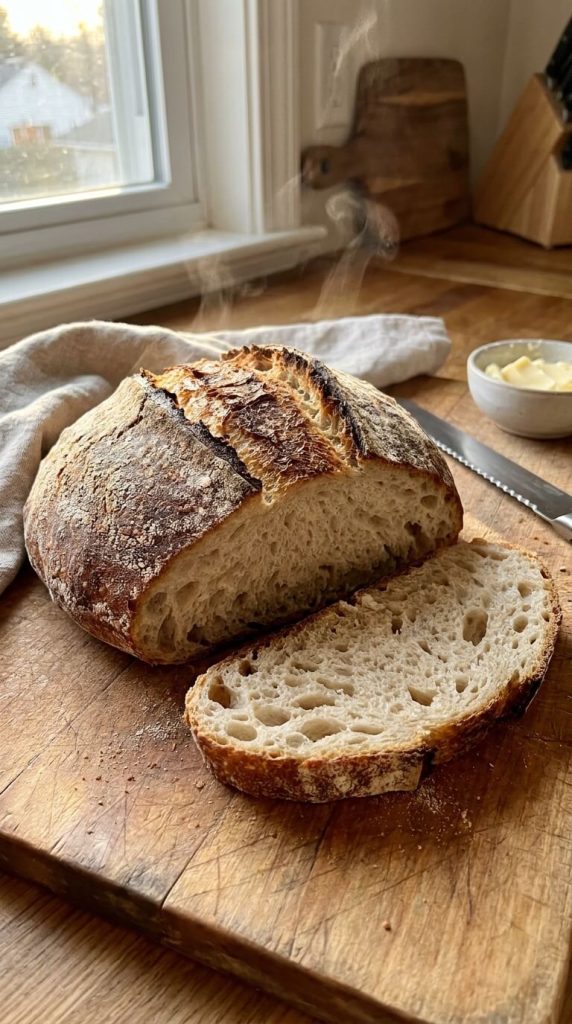
Looking to bake a rustic artisan loaf with a blistered, caramelized crust and an airy, tender interior?
This classic sourdough boule relies on simple ingredients and patience, using a Dutch oven to trap steam for maximum oven spring and a golden, crackled finish. It’s the ultimate loaf for slathering with fresh butter, dipping into soups, or making exceptional sandwiches.
A satisfying bake that brings bakery-quality bread straight to your home kitchen.
Description
This round sourdough loaf features a deeply blistered, rustic crust with a prominent slashed expansion score along the top. Inside, the crumb is open and chewy, with irregular air pockets characteristic of a high-hydration ferment. Baked in a preheated Dutch oven, the crust achieves a distinct crispness while preserving a soft, moist interior.
Suitable for intermediate bakers familiar with handling wet dough, stretch-and-fold techniques, and sourdough starter maintenance.
Timing & Yield
- Prep Time: 30 minutes (active)
- Bulk Fermentation: 4–6 hours
- Cold Proof: 12–16 hours (overnight)
- Bake Time: 45 minutes
- Yield: 1 large loaf (boule)
Ingredients
- 500 g bread flour (unbleached)
- 350 g warm water (70% hydration)
- 100 g active, bubbly sourdough starter (at peak)
- 10 g fine sea salt
Equipment
- Large mixing bowl
- Digital kitchen scale
- Proofing basket (banneton) or bowl lined with a flour-dusted linen towel
- Dutch oven with lid (cast iron)
- Parchment paper
- Lame or sharp razor blade
Instructions
- Mix & Autolyse:Whisk warm water and active starter in a large bowl until dissolved. Add flour and stir until a shaggy dough forms with no dry spots. Cover and let rest for 30 minutes.
- Add Salt & Build Strength:Dimple salt into the dough with a splash of water. Perform 4 sets of stretch-and-folds every 30 minutes over 2 hours. Cover the bowl between sets.
- Bulk Fermentation:Let the dough rise at room temperature until it has increased in volume by 30–50%, feels airy, and shows small bubbles on top.
- Shape & Cold Proof:Turn dough onto a lightly floured surface. Pre-shape into a loose round, rest 15 minutes, then shape tightly into a boule. Transfer seam-side-up into a flour-dusted banneton. Cover and refrigerate overnight (12–16 hours).
- Bake:Preheat Dutch oven at 230°C (450°F) for 45 minutes. Flip dough onto parchment paper, slash the top with a razor blade, and lower it into the hot pot. Bake covered for 20 minutes, then uncovered for 20–25 minutes until deeply golden brown.
- Cool:Cool completely on a wire rack for at least 2 hours before slicing to set the crumb structure properly.
Tips & Variations
- Mix 10–20% whole wheat or rye flour into the bread flour base for a deeper, nuttier flavor profile.
- Ensure your starter passes the “float test” (a spoonful floats in water) before beginning the dough.
- Never slice into hot sourdough immediately out of the oven; residual steam continues cooking the crumb as it cools.
FAQs
- Can I bake this without a sourdough starter?Yes—replace starter with 3 g (1/2 tsp) active dry yeast, but shorten the bulk fermentation time significantly as commercial yeast rises much faster.
- Why cover the pot during the first half of baking?Trapping steam allows the dough to expand fully (oven spring) before the crust sets and hardens.
- How should I store this bread?Keep cut-side-down on a wooden cutting board for 2 days, or store in a paper bag. Avoid plastic bags, which soften the crispy crust.
Would you like advice on adjusting hydration levels or troubleshooting your starter?