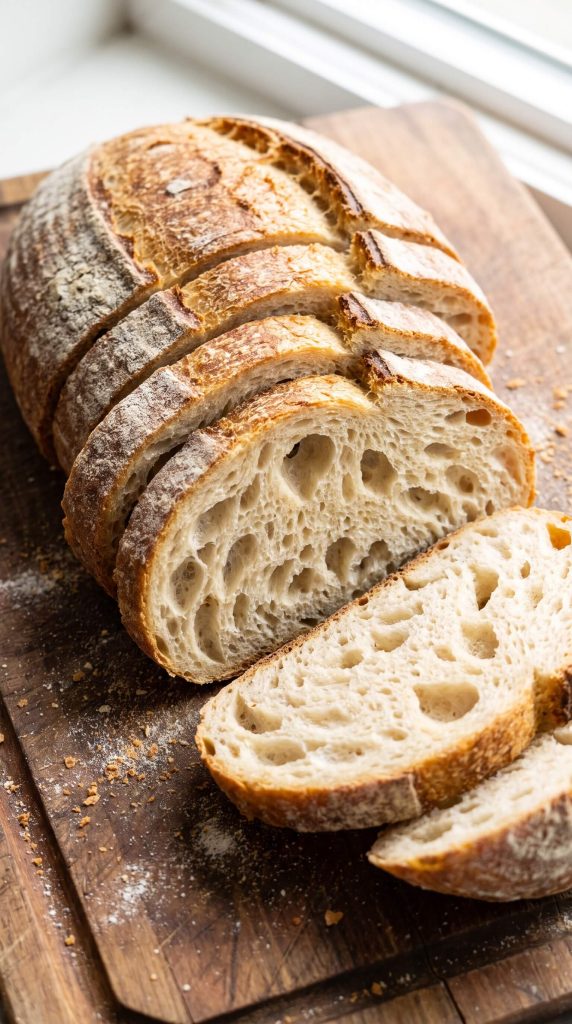
A crusty, flour-dusted oval loaf with an open, irregular crumb and deep caramelized crust.
Ingredients (makes 1 large batard)
- 100 g active sourdough starter (100% hydration, fed and peaked)
- 350–375 g water (room temperature; start with 350 g)
- 500 g bread flour
- 10 g fine sea salt
Instructions
- Mix
In a large bowl, mix the starter and water until mostly dissolved. Add the flour and mix until no dry flour remains. Cover and rest 30–60 minutes (autolyse).
Add the salt and work it in until fully incorporated. The dough will be sticky. - Bulk Fermentation
Perform 3–4 sets of stretch-and-folds every 30–45 minutes over the next 3–5 hours.
After the last fold, let the dough continue bulk fermenting until it has increased in volume by about 50–75% and looks airy with visible bubbles. Ideal dough temperature is around 75–78°F (24–26°C). - Pre-shape & Bench Rest
Gently tip the dough onto a lightly floured surface. Shape into a loose oval/log. Cover and rest 20–30 minutes. - Final Shape (Batard)
Shape into a tight batard (oval):- Flatten slightly into a rectangle.
- Fold the short ends in toward the center, then roll tightly from one long side, sealing the seam.
Place seam-side up in a floured oval banneton or towel-lined oval basket (or a rectangular container).
- Final Proof
Cover and proof:- Room temperature: 1–3 hours until it passes the poke test (springs back slowly).
- Or cold proof in the fridge: 8–16 hours (recommended for better flavor and easier scoring).
- Bake
Preheat a Dutch oven (or baking stone + steam setup) at 450–475°F (230–245°C) for 30–45 minutes.
Turn the dough out onto parchment, score with one long central slash or a few diagonal cuts.
Bake covered for 20–25 minutes, then uncover and bake another 20–25 minutes until deep golden-brown and the internal temperature reaches 205–210°F (96–99°C). - Cool
Cool completely on a wire rack for at least 1–2 hours before slicing so the crumb sets.
Tips
- Higher hydration (closer to 75%) gives a more open crumb.
- Cold overnight proofing improves flavor and makes scoring cleaner.
- For extra oven spring and blistering, ensure good steam in the first half of the bake.
- Best eaten the day of baking or the next day. Freeze slices for longer storage.
This produces the classic flour-dusted, open-crumbed sourdough batard shown in the photo. Enjoy!