A healthy, active sourdough starter is the foundation of great sourdough bread. Here’s a reliable way to create one from scratch and keep it strong.
How to Make a Sourdough Starter (Day 1–7+)
Ingredients
- Whole wheat or rye flour (for the first few days — helps fermentation start faster)
- Unbleached all-purpose or bread flour
- Filtered or dechlorinated water (room temperature)
Day 1
Mix 50 g whole wheat/rye flour + 50 g water in a clean jar. Stir well, cover loosely (lid not sealed), and leave at warm room temperature (75–80°F / 24–27°C).
Day 2
You may see a few bubbles. Discard most of the mixture, leaving about 50 g. Feed with 50 g all-purpose/bread flour + 50 g water. Stir and cover loosely.
Days 3–7
Each day: Discard down to 50 g starter, then feed with 50 g flour + 50 g water.
By days 5–7 it should become bubbly, rise predictably, and smell pleasantly tangy (not like nail polish or strong cheese).
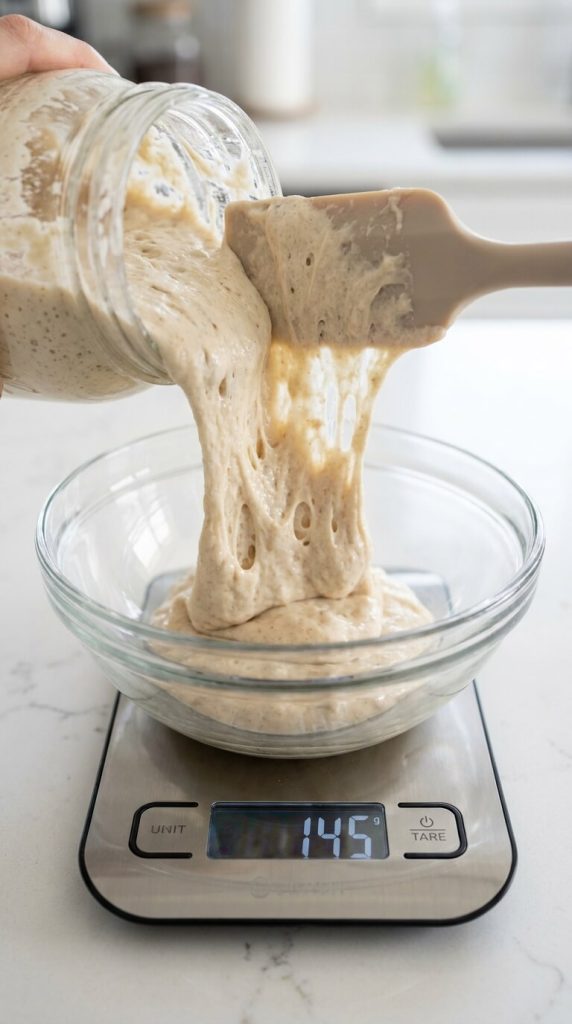
Your starter is ready when it reliably doubles in volume within 4–8 hours after feeding and looks airy and webby (like the one in your photo).
Daily / Weekly Maintenance
If baking often (counter storage)
- Keep at room temperature.
- Feed once a day: discard down to 50–100 g, then feed 1:1:1 (starter:flour:water) by weight.
If baking less often (fridge storage)
- Feed it, let it rise for a few hours, then refrigerate.
- Feed at least once a week: take it out, discard down to 50–100 g, feed 1:1:1, let it become active, then return to the fridge.
How to Prepare Starter for Baking
- Take your starter out of the fridge (if stored cold).
- Feed it 1:1:1 or 1:2:2 (starter:flour:water) and let it peak (become bubbly, doubled, and just starting to fall).
- Use the amount your recipe calls for (e.g., 100 g) when it is at peak activity — this is the stage shown in your photo.
Tips for a Strong Starter
- Use a kitchen scale for accuracy.
- Consistency matters more than exact timing — temperature affects speed.
- If it becomes too acidic or inactive, give it a couple of consecutive feedings at room temperature.
- A good starter should smell yeasty and pleasantly sour, with lots of bubbles and a stretchy, webby texture when poured.
Once your starter is active and doubling reliably, you can use it in any sourdough bread recipe. Would you like a simple beginner sourdough loaf recipe to go with it?